Build Quality:
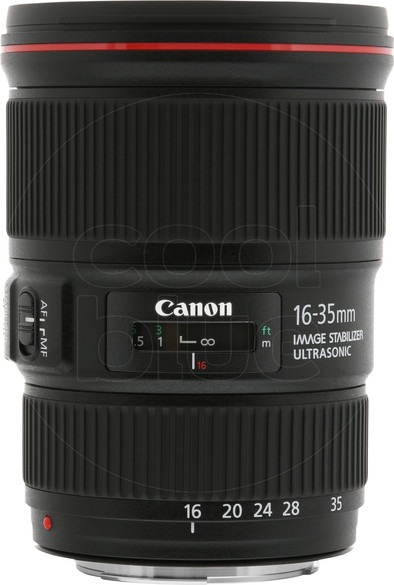
This is an L lens, which stands for luxury.
It's what you can expect. A solidly built lens with a metal mount as well as a rubber ring to keep out water and dust.
Inside, the lens is nicely finished with matte black.
The AF-MF as well as on/off buttons on the lens are smooth with a correct resistance, as are the focus and zoom ring.
The rings are ribbed and a pleasure to use.
You immediately notice that you have quality and so you can confidently take on your assignment!
Stabilization:
I don't think the 4 stops of stabilization is achieved, but a good 3 stops is certainly the case, in some situations I would dare to say 3.5. I took sharp pictures at 0.5 seconds handheld using the right conditions (breath control)
Image quality:
Sharp at f4 over the entire zoom range and, above all, not to forget: the extreme corners are also sharp!
This was a problem with Canon's previous wide-angle lenses.
Apparently they have found the solution! This is obviously a must for landscapes and architecture. Hooray for Canon!
The distortion is of course present, this is already typical for these types of lenses. Fortunately, this can easily be solved in Lightroom or other software with the lens profiles. Photoshop/adobe raw as well as lightroom therefore have the necessary lens profiles for these problems. So personally I don't take this too seriously.
In terms of chromatic aberration I can be brief: I haven't seen one yet and haven't had to make any corrections for it yet.
The bokeh is good, but not perfect, but we are talking about a wide-angle lens here. In general, the bokeh will suffice. No special features visible here and no onion effect.
You can only see that the bokeh is stretched slightly towards the corners, but in the center they are nicely round.
Vignetting is very good on an asp-c device and hardly noticeable at full aperture, but on a full-frame device it is certainly noticeable. I think you have about a 20% light loss towards the corners, but again this can be solved with the lens profiles in the software with which you edit the photos.
I think this comes into its own on the more recent devices with a good dynamic range. In dark situations you will notice that noise becomes visible in the corners with the restoration of the vignetting. This is due to the limited dynamic range of the earlier canon devices. If you do this on an 80d / 5d mark IV or on Sony devices, you will not be bothered by this.
Occasionally, flare or flare will crop up when you shoot against the sun, but again this is not so bad and can be an extra artistic element in some photos.
Autofocus:
A relatively quiet autofocus with high speed and superior precision. We can be very brief about this.
What do I use the lens for:
truck photography, landscapes and nightlife photography.
I tested the lens on the following devices:
small point of comment about using in combination of
a sigma mc11 on an A7 II:
In good conditions the lens focuses sufficiently quickly and reliably, when it gets dark it can still work very well, but in more extreme darker conditions it is best to switch to manual focus.
However, filming with off is a disaster, but this seems to be the case with every non-FE native lens on a Sony A7 device.
The pictures:
The 2 nightlife photos were taken in combination with a 5d mark III body, the other photos in combination with an A7II + sigma mc11
Thanks for reading and have fun with your choice!