Google Home Mini Gray (2018)
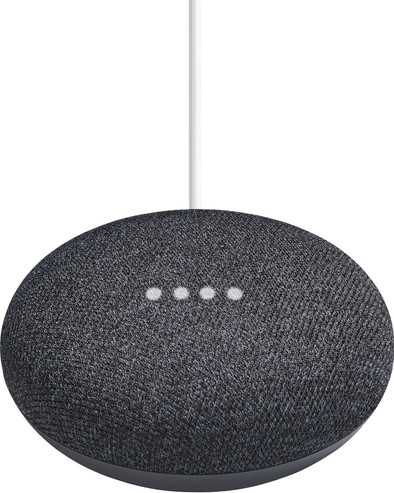
Never available again
View alternatives in the sidebar
View alternatives in the sidebar
Product number | 803758 | |
|---|---|---|
Manufacturer code | GA00216-NL | |
Brand | ||
Processing of your defect | Carry-in warranty | |
Old product returned for free |
Height | 8,8 cm | |
|---|---|---|
Depth | 21,6 cm | |
Width | 15,5 cm | |
Weight | 1 kg | |
Color | Gray | |
Material | Fabric, Plastic | |
Built-in screen | ||
Built-in microphone | ||
Water-resistant |
Power supply type | Power grid |
|---|
Link to router | Wireless | |
|---|---|---|
Multi-room audio | ||
Multi-room functions | Make a stereo pair, Surround sound mode, Zones separately, Zones simultaneously | |
Plays from network | ||
AirPlay | ||
Google Cast | ||
Spotify Connect | ||
Bluetooth | ||
Bluetooth profiles | Hands-Free Profile (HFP), Headset Profile (HSP), Remote control (AVRCP), Standard Audio (A2DP) | |
NFC | ||
Streaming services | Deezer, Google Play Music, Netflix, Spotify, TuneIn, YouTube | |
Number of devices that can be paired | 1 |
Controls via app | ||
|---|---|---|
Compatible with smartphone / apps | ||
Controlled via Apple app | ||
Controlled via Android app | ||
Controlled via Windows app | ||
Linkable to home automation | ||
Control panel included | ||
Smart home platform | Google Assistant, IFTTT, Works with Nest |
Voice control | ||
|---|---|---|
Clock speed | 1,2 GHz | |
Frequencies | 2400 | |
Number of frequency channels | 2 | |
Protocol | Bluetooth |
Guaranteed support with updates | 36 months after release date | |
|---|---|---|
Year introduced | 2018 | |
Introduction month | November |
Smart home platform | Google Assistant, IFTTT, Works with Nest | |
|---|---|---|
Power supply type | Power grid | |
Voice control | ||
Linkable to a protocol |
According to our smart home hub expert
With voice control, you're always informed about your calendar, the weather, traffic, and all other Google knowledge.
Thanks to voice control, you can carry out tasks without using your tablet or smartphone.
The speaker can distinguish up to 6 voices, which means you can use the device with multiple people.
The Flemish version of Google Home is not yet available.
You need a Google account to be able to use functions such as calendar management.
The Google Home Mini speaker is your hands-free help around the house. You can ask questions or give this smart assistant commands. The assistant can be set per language and country. You'll receive the most up-to-date information on things like train schedules, the weather, and the news of the country you've set. This isn't available for Belgium yet. With the smart speaker, you'll know right away when your first meeting is scheduled. You can order it to play music or dim your smart lights. Thanks to voice recognition, up to 6 people can use the speaker. Connect the smart speaker to AC power, then use Bluetooth to link it to the Google Home app on your smartphone. Adjust settings like the speaker's spoken language and the temperature indication. Connect the speaker to a Google Chromecast to use voice control to stream videos to your television via the speaker, and to connect the Mini to other Google Cast-supported speakers for higher sound quality.
Note: the Google Home Mini is a digital assistant. Want to be able to play music with the Google Home Mini? Then you should connect it to other Google Assistant-compatible speakers in your home.
Note: Google Home's Flemish version isn't available yet. This means you'll have to use the Dutch or French version in Belgium. When you ask Google Home questions about the news or the weather, for example, it'll give you answers relevant to the Netherlands or France. Of course, the other smart options, like controlling your lighting, your thermostat, or your music, are available.
Sound quality
Installation & user friendliness
Google Home is already way further than I thought with smart home automation. Forget Siri, forget Alexa, they had a market edge until recently. But Google has gone up and over in one year. Especially now that all kinds of manufacturers have adopted the Google Assistant technology and are making applications.
At first glance and at first use, it is mainly a nice gimmick. But once you start to understand how the artificial intelligence of the Google ear works in the Internet, you will discover that the Google Assistant can already do a lot for you. Kneading the dough with your hands, and forgot something about the recipe? Ask with "Hey Google" and the smart speaker will tell you. In a discussion with friends where you miss or dispute a fact? Ask it, for example "Okay Google, how many inhabitants does France have?" And the Google Assistant flawlessly spoons the answer for you. It is also striking how much fun children find the question and answer game. They're suddenly asking all kinds of things where I'm like, "OK Google, "how big is the Earth?" And "Hey Google, who are you?" And how old are you Google?" The Google Assistant answers flawlessly. A (bland) joke will also tell Google if you want to.
Google often answers a question with "I don't know how I can help you with this yet". I've learned that that doesn't necessarily mean that Google can't be helpful yet. I discovered this because I often got that response when I wanted to control a smart switch or a WiFi-controlled LED strip, while I was sure that Google could control it. But a command I programmed as "Hey Google, table lamp on" responds perfectly to a repetition of exactly that phrase, but does not respond well to "Hey Google, turn on the table lamp" while the politely worded version "Hey Google may table lamp on " or "Hey Google, table lamp on please" respond perfectly. Apparently the self-learning algorithm of the Google Assistant is still a bit picky. So choose your commands carefully and explore through the Internet what can be done with Google Assistant and you will find that there is already an incredible amount if you stick to the code of conduct and the ever-growing possibilities of Google Home and you will hear less and less "I don't know how I can help you with this yet."
If you start programming with tools such as IFTTT commands, then the possibilities and the natural speech character of the conversation suddenly become much greater. The learning curve of Google Home Assistant is suddenly a lot bigger. I have to remember which commands I can say and how they are followed. Especially when combined with all kinds of smart power strips, wall switches, lamps, kitchen appliances, TV and computer, etc. I find that I have to get used to the Assistant, just like the Assistant's algorithm has to get used to me. But all in all, this small speaker gives the feeling of a long future with many more possibilities.
Don't see the speaker too much as a music device, the sound is okay, even very good for speech applications, and you can of course just play a Spotify playlist on it, but it is primarily intended for information processing. If you have higher demands for entertainment, take a look at the larger Google Home speaker or even better, stream to a good HiFi system. For smart home applications, on the other hand, the small Google Home speaker is an unprecedented amount of value for money.
And about privacy, well, we will undoubtedly be able to have very interesting discussions there. My advice is to handle the device with the awareness that you need to protect your own privacy if necessary. So turn off the speaker for a while if you think it's necessary at that moment. Just like you may not want to just type every search query into your search engine,... Anyway, I do know that I am definitely stepping into smart home developments with full conviction and don't want to miss my Google Home speaker for anything anymore.
Peter De Weerdt
5 January 2019
Automatically translated from Nederlands
When I got home, I met the postman and immediately unpacked and connected everything after handing over the box. Linked to my IKEA lamps.
In the morning I start with reading my agenda and switching on a number of lights in the house, followed by the news and then our favorite playlist.
The mini makes it almost impossible to get out of the house and we are all very happy when we are back in the evening. Groceries? We talk to Appie and then have it delivered. Life is made so much easier by this Google Home Mini and I can recommend everyone to get acquainted with this and make your life a lot easier and more fun!
Martijn Rouwen
18 December 2018
Automatically translated from Nederlands
In addition to the practicality of this device, the jokes and riddles you can ask are a very nice plus!
Dave
6 May 2019
Automatically translated from Nederlands