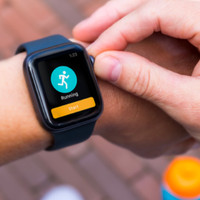
After having used an iWatch for half a year, and that is with flying colors the best smartwatch of the moment, due to circumstances back to an Android phone. Unfortunately I also had to look for another smartwatch due to incompatibility.
Because of previous less experience with proprietary OSs, I wanted to go for AndroidWear.
My smartwatch must be 1. a remote control of my smartphone. 2. Have outdoor functions and navigation. 3. own fitness apps and 4. of course have standard watch functions.
-
As an electrician I am on the road a lot. Basically, I never want to have my phone in my hand behind the wheel. I want to have read an incoming SMS or WhatsApp within a second. Operating TuneIn internet radio (at the red light or the like) should also work. Thanks to the Android Wear 2.0 OS, this all works fine. You could also reply to SMS with thin fingers, but that's not for me. Reading is already OK.
As long as you open the display brightness further at the start of a sunny day, the readability has always been more than sufficient until now. An automatic light setting would have been very welcome.
-
In my spare time and on vacation you can always find me somewhere in a forest. It is important to have a compass, altimeter and topographic maps with you.
Viewranger topographic maps works incredibly well on this watch. Set everything up on the smartphone and you can follow the route nicely on a clear map on the watch screen. Kudos to you, this is even better than on the iWatch.
Earlier "ProTrek" watches from Casio also had altimeter and compass. The disadvantage: you always had to calibrate the altitude manually. Because this Casio now has a GPS, I thought the device calibrates automatically. Unfortunately peanut butter, he should, but the height is never right. Calibrate manually beforehand, the altitude measurement later in the day works fine. That's a big setback; I don't know in unknown territory, of course.
-
In the absence of a heart rate monitor, complete monitoring is of course impossible. You can use the standard Google Fit apps during walking/cycling tours. Unfortunately very limited: time, distance, time per kilometer and estimated calorie burn are tracked.
The Casio activity app does better. You see the elevation increase, you can follow everything neatly on a map in addition to the options that the standard Google Fit also offers. However, this app is meant to be in the mountains: it always asks to set a target height. In the flat Mechelen landscape you don't need this during a relaxing walk...
-
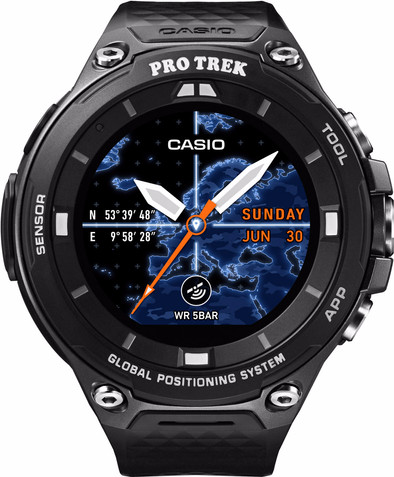
Watchfaces etc. available in abundance, but what makes this Casio special is its double LCD display. You can set it to continuously display a watchface, but your battery won't last a full day. Only showing the watchface with a rotating wrist a. not accurate; you have to swing that wrist quite seriously to get an image on it and b. if you often sit at the wheel, the reverse: the watchface often comes on unintentionally, which is detrimental to your battery consumption.
I set it up that you have to touch the screen or a button before you see a watchface. On the ordinary monochrome LCD you can see the hour, date and seconds. With GPS on I can easily do 3 days with a battery that way. With GPS from a week. Attention: during the night I switch on Timepiece. A kind of energy saving mode in which the watch only becomes a "normal" wristwatch. Interesting: you also have a background light to read the time in the dark.
Apart from the lack of the heart rate sensor, it is the best (most complete) Androidwear watch of the moment I think, which also looks good.
About the latter: if a smaller person wears that watch, it's a crazy sight, because it's quite an oversized box. Myself, almost five feet 90, makes the ratio come out a little better.
The top around the display seems rather plasticy for a watch of that price range. Knowing that it has been given a military category for durability. The future will show this; after a month on my wrist it is still pristine.