Canon EOS 80D Body
Never available again
View alternatives in the sidebar
According to our SLR camera expert
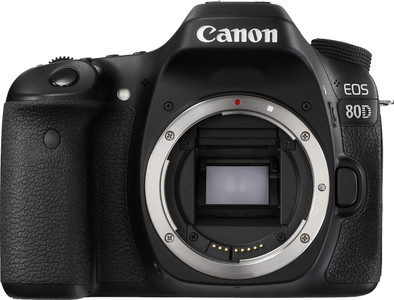
The Canon EOS 80D is a robust and fast single-lens reflex camera. This camera has a 24.2 megapixel sensor and DIGIC 6 image processor. The camera takes pictures at 7 frames per second, allowing you to capture moving objects perfectly on camera. The hybrid autofocus has 45 cross-type focus points, making it possible to shoot sharp images in low light. The touchscreen allows you to set the camera's focus, take photographs, swipe through your image library, and adjust the camera settings. Use NFC to send photographs to your smartphone, tablet, or printer.
Lens included | ||
|---|---|---|
Type of image sensor | APS-C | |
Type of image definition support | Full HD (1080p), HD ready (720p) | |
Camera usage situation | Sports photography, Vacation | |
Suitable for photographer type | Advanced | |
Autofocus | ||
Viewfinder | ||
Image stabilization |
5 stars
66
4 stars
25
3 stars
1
2 stars
0
1 star
0
Introduction: Let's get straight to the point: The Canon 80D is what the 70D should have been! Good noise performance, a speed monster with reliable AI servo mode and countless extra functions! A great device for traveling and some professional assignments!
Focus System: 45 points and all cross type. This alone is something to applaud. The center point is even more sensitive than the human eye in dark conditions. This one goes to -3EV!! Nice to photograph start rails or the like. I wouldn't go higher than 2000 in ISO. This unit is an asp-c not a full frame. Tests on my parent's dog, kids show that the AI servo is certainly reliable, but of course not up to the level of the 7d mark III or a 1dX. For nature photographers there is a very nice plus! Your 100-400 together with a 1.4x converter from canon will still work perfectly outside of slightly delayed focus and this with 27 focus points!!! Hooray for the Canon 80D! There was a time when I could only do this on my old canon 1d mark IV and not even on the 80d level. Don't forget the AF during live view or filming. This works very smoothly and relatively quickly. Especially compared to the competition in the dslr world. The response speed when focusing by adjusting it on the touch screen is as easy as it is applicable. Filming with a dslr is suddenly accessible to everyone! This works slightly better and smoother than on the 70D.
Image quality and video: The sensor is an asp-c 1.6x in size. Like every canon in this segment. This is supported by a Digic 6. However, the way in which the sensor has been developed ensures that it improves a lot on dynamic range (shadow details, among others) compared to the previous generations. This soon becomes clear if you make the RAW files up to 3ev brighter or remove the shadows on max in lightroom, dpp or photoshop. Where there used to be banding and a lot of noise, this now seems to remain largely beautiful in terms of details and noise at ISO 100. From -4 noise became visible and at -5 not really usable. Keep in mind, however, that even the canon 5d mark III and the 6D at -1 already conjured up noise and that lens profile corrections in the vignetting plane could also cause problems. I can only applaud this achievement and it certainly comes in handy! Especially urbex and landscape photographers or interior will be very satisfied with this. Keep in mind that Canon is not yet at the level of the Sony sensors in the Nikon devices and their a7 series, but the difference compared to the previous generations is certainly sublime. In terms of noise performance at high ISOs, everything is perfectly usable up to EM 1600. 3200 is certainly still ok, but the noise is noticeable and 6400 I would actually avoid like the plague. However, I am a pixel peeper. So for some people, 6400 will still be fine. The megapixels have been bumped up to 24. Video is possible at 1920 x 1080 at 60fps and produces excellent footage. Due to the dual pixel and the possible operation via touch and then again a live view screen that is fully foldable and can even be rotated, filming is a pleasure with this dslr!
Construction & use: The device feels solid and is protected against the elements. This isn't at the level of a 1dx though, but it can certainly survive some beatings. To withstand the elements well, it is best to use a lens that can also tolerate something and is weather resistant. This is partly due to the rubber seal on the back of a solid lens. In terms of use, the device is super in the hand. It remains a pity that there is no joystick like the 5D and other top devices to choose the focus points. This remains like the 70d, 60d and the 6D via the wheel. Unfortunately I'm not a fan of that, but you get used to it.
Functions: HDR is present. However, this is only usable in JPEG, but it's a nice extra. Also 'multiple exposures' is available. This provides some nice possibilities. This was a regular occurrence at the time when movies were used. You should google it to find out exactly what this means. WIFI and NFC make sharing photos via your smartphone super convenient and for the social media freaks among us: indispensable! However, I will remain brief about the functions. Finally, the image quality and focus are just about the most important, but know that the learning curve and options with this device is higher than with such a xxxxD or an xxxD device. Boredom does not apply here. This device can also control other Canon flashes from a distance and can therefore be used as a master. The built-in flash is otherwise useless. Conclusion Canon has finally made an asp-c device that could pique my interest once again. Hopefully they carry this strategy through to their 6d mark II or 5d mark IV in the future! So far I will keep my 6d and 5d mark III for professional nightlife reports. The image quality and noise/iso ratio naturally continue to take the lead over asp-c devices. For everything else, I will certainly use the 80D regularly for the time being, because the extra dynamic range has become indispensable. 80DÂ…You are the best! Thank you Canon!
Miguel Vermeulen
19 May 2016
Automatically translated from Dutch
I bought the 80D to replace the 1200D that got me into photography about 2 years ago.
What a world of difference!
FYI: I mainly photograph riders at competitions and training.
AutoFocus:
With the 1200D I focused with the center AF point, which resulted in a lot of blurry photos because it is not so easy to keep that one AF point on the horse-rider combination. Using all the AF points does not help because they are too far apart.
However, with the 80D's 45 AF points, it's child's play because there is always an AF point on the subject and the amount of photos to be thrown is drastically reduced.
100% viewfinder:
Making a composition with the 80D is so much more pleasant than with the 1200D, because the viewfinder of the 80D shows 100% of the shot, while with the 1200D this is only 95%. It is no longer a matter of guessing whether a subject is or is not completely in the photo!
High ISO:
The 1200D has a maximum ISO of 6400, but from ISO 1600 the noise is so ugly that the photos are actually no longer usable due to the (color) noise.
With the 80D you can raise the ISO to 12800 and still have usable photos. It turns out that with the 80D especially the less disturbing luminance noise (difference in brightness) appears, while with the 1200D mainly color noise (difference in colors) occurs.
Fast Drive Mode:
With the 1200D you can take 3 photos per second. That is not enough to be useful during the fast maneuvers that riders perform with their horse at, for example, reining competitions or jumping. In the end it comes down to having the right timing to make the recording. So it's up or down.
With the 80D you take about 7 photos per second in the high-speed drive mode. With good timing, you have a much better chance of capturing the right moment.
These are the main advantages of the camera for me. I have not yet mentioned how much easier it is to operate the menus with the touchscreen and that you can easily send your recordings directly to a smartphone or other WiFi device.
Against all these goodies is of course the fact that the device is more expensive than an entry-level model, but you also get so much more!
A small downside is that the device with its 730g is a lot heavier than the 480g of my previous device. But since my lenses are also a lot heavier than the standard kit lens, this actually makes for a more balanced system to operate.
Jan D'Hollander
19 December 2016
Automatically translated from Dutch
I am a person who does not just spontaneously buy something. I read many reviews and keep up to date with technology. In combination with a good lens, the eos 80d is a winner for its budget. I hesitated between a 7D mark2, the eos 80d and the 6d, but because I don't earn my living with it, I chose this one! The device has and offers everything of the 7D mark 2 but with better newer soft and hardware. The only advantage of the 7D is that it has a dual processor, but for me that does not outweigh the extra cost and the negatives compared to the 80d. The 80d is lightning fast with its 7fr/s. I bought this to replace my 550d that I've owned for about 6 years and everything is beyond compare. So much better, more beautiful, more professional in terms of settings, shortcuts, navi and focus via touchscreen. The 6d is of course a full frame camera but has no touchscreen, no built-in flash,... older processor and also dates from a few years ago. I still have 2 ef-s lenses that I use frequently and that's why I made the decision. I can talk for another hour about the fantastic device. Highly recommended for the better amateur photographer or semi-pro or as a second device for a pro. If you can wait and have a bigger budget, I would probably wait for the eos 7D mark 3 but a release date is not yet known.
Beere
27 April 2018
Automatically translated from Dutch
Are you seriously considering buying the Canon EOS 80D, but would you like to know more about the product? We examined this single-lens reflex camera and wrote an expert review about it.
Product number | 698457 | |
|---|---|---|
Manufacturer code | 1263C027AA | |
Brand | Canon | |
Warranty | 2 years | |
Processing of your defect | Carry-in warranty | |
Old product returned for free |
Camera type | Single-lens reflex camera | |
|---|---|---|
Suitable for photographer type | Advanced | |
Camera usage situation | Sports photography, Vacation | |
Menu language | Arabic, Dutch, English, French, German, Italian, Multilingual, Polish, Russian, Spanish, Turkish | |
Best tested |
Lens included | ||
|---|---|---|
Lens mount | Canon EF mount, Canon EF-S mount | |
Autofocus | ||
Type of autofocus | Phase detection autofocus |
Type of image sensor | APS-C | |
|---|---|---|
Crop factor | 1,6 | |
Effective number of megapixels | 24,2 MP | |
ISO sensitivity | 100 - 25600 |
Image processor type | DIGIC 6 | |
|---|---|---|
Photo file format | JPEG, RAW | |
Video file format | MOV, MPEG-4 AVCHD (H.264) | |
Audio file format | Linear PCM, aac | |
Type of image definition support | Full HD (1080p), HD ready (720p) | |
Full HD (1080p), frames per second | 24p, 25p, 30p, 60p | |
HD ready (720p), frames per second | 25p, 30p, 50p, 60p | |
Maximum number of photos per second | 7 fps | |
Image stabilization | ||
Number of focus points | 45 |
Memory card | SD | |
|---|---|---|
SD memory card version | SD, SDHC, SDHC UHS, SDXC, SDXC UHS | |
Expandable storage capacity up to | 128 GB | |
Minimum requirements storage system | Class 4 |
Internal flash | ||
|---|---|---|
Exposure compensation | 10 | |
Guide number | 12 | |
Wireless flash control |
Screen size | 3 inches | |
|---|---|---|
Tiltable | ||
Touchscreen | ||
Number of pixels | 1040000 pixels | |
Number of focus points | 45 |
Viewfinder | ||
|---|---|---|
Viewfinder type | Pentaprism | |
Viewfinder size | 0,59 inch | |
Diopter adjustment | -3 - 1 dpt |
USB port | ||
|---|---|---|
USB version | USB 2.0 | |
HDMI connector | ||
Type of HDMI connector | Mini HDMI Type C | |
Microphone connector | ||
Type of microphone connection | 3.5mm jack | |
Hot shoe | ||
Hot shoe type | Hot shoe |
Built-in WiFi | ||
|---|---|---|
Bluetooth | ||
NFC | ||
GPS sensor |
Battery type | Canon LP-E6N | |
|---|---|---|
Battery/battery capacity | 1865 mAh |
Weight | 730 g | |
|---|---|---|
Height | 10,52 cm | |
Depth | 7,85 cm | |
Width | 13,9 cm | |
Material | Plastic | |
Color | Black |
Water resistance | Splash proof | |
|---|---|---|
Water-resistant | ||
Dust removal system |