Written by Gaby
Edited on
8 May 2023
·
07:55
Which baby monitor connection do you choose?
A baby monitor transfers the sound or image via a PMR, DECT, digital, or WiFi connection. The connection type affects the range, interference, and the option for expansion. In this article, we'll explain the advantages and disadvantages of different baby monitor connections to you.
Compare connections
| PMR | DECT | Digital | WiFi | Dual mode | |
|---|---|---|---|---|---|
| Range indoors | Up to 100m | Up to 50m | Up to 50m | Unlimited | Unlimited |
| Range open field | Up to 3000m | Up to 300m | Up to 300m | Unlimited | Unlimited |
| Interference-free | No | Yes | Yes | Yes | Yes |
| Option to expand | No | No | Yes | Yes | Yes |
| With app | No | No | No | Yes | Yes |
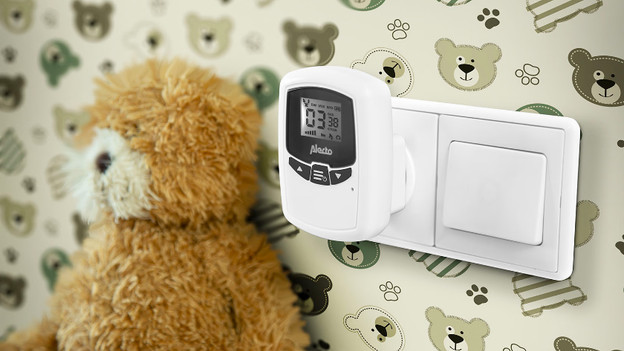
PMR: large range and expandable
PMR baby monitors work the same way as classic analog baby monitors. They're radiation-free and often communicate via electromagnetic waves on PMR frequencies. PMR has a major advantage over standard analog baby monitors, which is the large range of up to 3km in an open field. Useful, when you often sit in the back of your garden or stay at the campsite. A disadvantage of PMR baby monitors is that they aren't interference-free and communicate via an open channel. You can easily expand this version with extra baby units.

DECT: 100% interference-free
When you choose a DECT baby monitor, you're sure no one is listening along. That's because this baby monitor with DECT technology is secured and 100% interference-free. You can't expand a DECT baby monitor with extra baby units. When you want to keep an eye on multiple children, you'll need to purchase a separate baby monitor for each room. With a range of up to 300m outdoors and up to 50m indoors, you'll have a stable and reliable connection with a DECT baby monitor.

Digital: 100% interference-free and expandable
Just like with a DECT baby monitor, you'll listen to a 100% interference-free, secured connection with a digital baby monitor. The advantage of a digital baby monitor is that you can expand it. This allows you to keep an eye on 4 children via one parent unit. These baby monitors have a range of up to 300m outdoors and up to 50m indoors.

WiFi: unlimited range with app
A smartphone baby monitor or WiFi baby monitor is connected via WiFi. As a result, you'll always be in range. You can add extra users to the app, so your partner can keep an eye on the nursery on their own smartphone. With most models, you can also expand the baby monitor with an extra camera. A disadvantage of these baby monitors is that you need a stable WiFi connection. When the WiFi goes out, the baby monitor will stop working too.
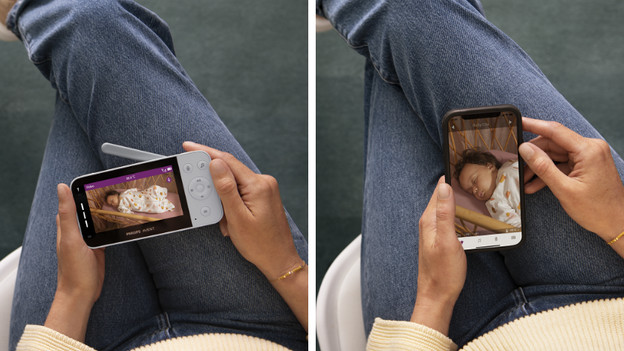
Dual mode: parent unit and smartphone app
A baby monitor with dual mode gives you the best of 2 worlds. You can watch your baby both via the parent unit and on your smartphone or tablet. Thanks to this, you'll have a stable and interference-free connection with your baby room while at home. You can watch your child via the app on your smartphone when you're outdoors. The indoor range is similar to the range of a digital baby monitor. Outdoors, you switch to an unlimited range thanks to the WiFi connection.
Conclusion
The main difference between the baby monitor connections is the range and the option for adding extra baby units. You can often expand your PMR, digital, and WiFi baby monitors with an extra baby unit. WiFi and dual mode baby monitors have unlimited range, but do depend on a strong WiFi connection.
Article by Gaby
Baby Monitor Expert.